
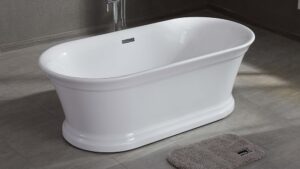
The first question in an acrylic versus fiberglass tub comparison is what you would be bathing against. Acrylic is a surface material. Fiberglass can sit behind that surface as reinforcement, so its presence doesn’t rule out an acrylic bath. The alternative usually meant by a fiberglass tub has gelcoat on the face.
The two finishes bring different care and repair considerations. Acrylic has some useful surface advantages, explained below, but those advantages do not select a bath for you. A model still has to be the right shape, fit the bathroom and make sense at its complete price.
Acrylic and Fiberglass Describe Different Parts of a Tub
Look at the inside of a bath. That continuous surface is where water, skin and cleaning products meet the tub. In the acrylic construction discussed here, it is formed acrylic sheet. In the conventional fiberglass alternative, it is gelcoat over fiberglass backing. An acrylic sheet can also have fiberglass reinforcement underneath it. The visible finish and the hidden backing are separate parts of the description.
The U.S. Department of Housing and Urban Development illustrates these constructions in a guide to tub surfaces and repairs. Its older prices aren’t a basis for budgeting today, but the construction descriptions help make sense of the names.
In a specification that says only “fiberglass body,” the missing detail is the finish. Ask for that before comparing cleaners or repairs. Once you have it, keep the surface and reinforcement separate in your notes.
You may find that two differently advertised baths both have an acrylic face and fiberglass backing. The apparent material choice has disappeared. There may still be good reasons to prefer one, but you will find those in the model details, not in the different names the sellers used.
How Surface Construction Changes Everyday Use
After the bath has been fitted, the finish is the part you will keep looking at and cleaning. This is why two otherwise appealing models deserve more than a quick comparison of their color. The finish you order, its care instructions and the available repair advice all belong in the decision while the choice is still open.
Finish and cleaning
A bright reflection along an oval bath’s rim may be part of what caught your eye in a photograph. The glossy surface shown here gives you a specific finish to consider. Check the finish on the model you intend to order rather than assuming that every acrylic bath will look the same.
The Gurgle oval acrylic model described below is shown with a glossy finish, with mild soap and water recommended for cleaning. For the gelcoat bath on your shortlist, get its own care instructions. Compare what you would actually do to keep each finish clean, including whether you would need to change the products you already use.
Keep those instructions with the model details. A general recommendation for a “fiberglass cleaner” leaves you with the same unanswered question about the surface. It is the finish that needs to be compatible with the cleaning product, not the reinforcement behind it.
Repairs are surface-specific too
HUD’s guide describes sanding and buffing as an option for some acrylic scratches and directs gelcoat damage toward an appropriate specialist repair. The practical lesson is to identify the finish before anyone works on it. A new tub’s manufacturer should advise on the damage and the repair, including any warranty implications.
One reason to favor acrylic is its harder finish relative to polyester gelcoat, as described by HUD. That is useful background for thinking about surface wear, with no need to promise that an acrylic bath cannot be scratched. Damage through the shell is a separate matter. If that is the problem, a discussion confined to polishing out a mark has missed the job that needs doing.
For a new purchase, find out who you would contact about a damaged finish. A repair option is more useful when there is someone to assess the actual mark and explain the likely result. Include that practical support in the comparison, especially if a visible patch would bother you enough to reconsider the bath.
Compare the Complete Tub, Not Just the Material Label
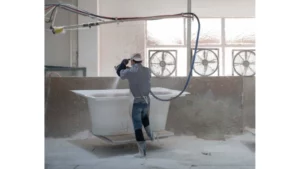
The factory image in this section shows reinforcement work, a part of production hidden by the finished appearance. It helps explain the distinction between surface and backing. It doesn’t show a measured wall thickness or establish the strength of the oval model; those would require different evidence.
The shape you will use
Sometimes the photograph has already made part of the choice for you. You want the oval outline visible from across the room, with the bath standing clear of the walls. An alcove model wouldn’t give you that appearance, whatever its finish. In that situation, compare freestanding candidates with each other first. Otherwise the contrast between layouts can easily be mistaken for a preference about acrylic and gelcoat.
Then look inside the outline. The outside length includes the rim and the space occupied by the sloping ends; your legs don’t have all of it to themselves. A bowl drawing helps explain where that length goes. If you can try the bath, the position of your back and feet gives you another part of the answer. Neither the material nor the overall length is a substitute for that internal shape.
There is a similar trap in judging a display bath by how it moves. Its temporary support may differ from the installation it requires at home. Before attributing that impression to acrylic or gelcoat, establish how each model is meant to stand, including its reinforcement, base and specified supports. The installer will need those details. For the move into the room, the empty weight and access dimensions are more useful than the material name.
The offer you will pay for
The lower shell price may not produce the lower bill. A pop-up drain and overflow could be included with one bath and charged separately with the other. Delivery and the installation work also belong in the comparison. With both quotations covering the same items, you can see the actual premium you would pay for your preferred model.
You might willingly pay more for the acrylic finish, or find the gelcoat bath just as appealing. But what would a claim about warmth add to the offer? You would need to know about the insulation and see comparable evidence of heat retention before paying for that advantage. The surface name leaves it unanswered. The same goes for lifespan. Installation and years of use and upkeep are still ahead of you; neither surface label tells you how those will turn out.
If acrylic is now your preference, the acrylic bathtub buying guide takes the discussion into layout and model selection. Material terminology has done its job by this point. The remaining choice is between actual baths.
Where an Acrylic Freestanding Tub Fits
For a specific acrylic example, consider the حوض استحمام بيضاوي أنيق قائم بذاته مصنوع من الأكريليك from Gurgle. Its construction brings the two material descriptions together: acrylic sheet with glass fiber and resin reinforcement. The finished bath is an oval on a pedestal-style base.
On a room plan, allow for its overall measurements of 1700 by 800 by 580 mm. The 1700 mm is the outside length; the distance inside the bowl available for your legs is a different measurement. It would be frustrating to work out where the bath will stand and only then discover that the interior isn’t the shape you wanted. Keep both views of the model in mind as you consider it.
The glossy bath is supplied with a chrome-plated pop-up drain and overflow set. That gives you something definite to enter in the fittings part of your comparison. The other quotation may look cheaper before those items have been added. It may still be cheaper afterward, but at least you will know what each price covers.
There are other bath and spa options on the قرقر homepage. If you want to pursue this one, discuss your bathtub requirements with the team. Name the oval model and the finish you want, and include your available space and the installer’s fitting requirements. That gives the conversation somewhere to start beyond a general preference for an acrylic bath.
خاتمة
Acrylic earns its place in the comparison through a harder finish than polyester gelcoat and the possibility of treating some surface scratches. The limits matter just as much: it can still be damaged, and advice for a superficial mark will not cover every fault.
If those surface properties are high on your list, carry that preference through to an acrylic model whose shape and complete price also suit you. If a gelcoat bath fits the project better, clear care instructions and suitable repair support may make it the more appealing purchase. By then, the choice is about what each bath offers you. Seeing fiberglass in the acrylic model’s construction needn’t distract from it.
التعليمات
Q1: Can I use an acrylic repair kit on a gelcoat bath?
A1: Read the kit’s stated applications before opening it. Does it actually list the finish on your bath, or did you choose it because the color looked right? Those are different things. Match the application to the identified surface and follow the bath manufacturer’s advice. Calling a product a bathtub repair kit doesn’t establish that it works on both acrylic and gelcoat.
Q2: Can the color tell me whether my tub is acrylic or gelcoat?
A2: White doesn’t distinguish them. The model identification is more useful than the color when an existing bath needs repair. If you cannot find it, take the identification question to the supplier before choosing a surface-specific treatment; a photograph of a white finish alone does not settle which construction you have.
Q3: Is the longer warranty the better reason to choose one tub?
A3: The number of years is only one part of the offer. Put the covered faults and conditions alongside the duration for each bath. If those differ, a longer period isn’t a like-for-like benefit. It could still be valuable, but you need to know what remains covered during it.


