
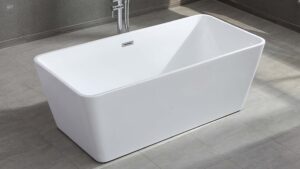
How long do acrylic tubs last? Construction, installation and care make a fixed replacement age a poor guide to an individual bath. For one already in use, condition is more informative: a change in appearance may call for different work from movement or a suspected crack. For a new bath, the specification is a better starting point than a lifespan number that has not been established for that model.
A small visible repair on a comfortable acrylic freestanding bathtub may be acceptable to you. Rocking underfoot raises another question, about the installation, which a better-looking finish would leave unanswered. The distinction helps keep the decision focused on the bath in front of you rather than its age alone.
What Counts as the End of a Tub’s Life?
Choosing a new tub involves thinking some distance ahead. The shape and size have to work now, but you’ll also be living with the cleaning routine and finish. It is reasonable to find out what help would be available if a fitting or the surface needed attention later.
“Last” needs some care as a description. A tub can leave a bathroom because the owner wants a different room, even when the old fixture is usable. Another owner may keep one with a repaired scratch. Both decisions are understandable, but neither gives us a date when the acrylic itself would have failed.
This leaves room for judgment when you own an older tub. You can investigate a repair to an otherwise satisfactory fixture without assuming that its age makes the effort pointless. The repair decision later in this article starts with the defect, rather than a calendar.
Acrylic Sheet, Reinforcement, and Support
What sits behind the bathing surface
Gurgle uses pure acrylic sheet for the bathing surface of its minimalist freestanding model, with glass fiber and resin for reinforcement. When you clean the tub, it is the acrylic face you are working on. The backing does another job, supporting the formed shell.
When comparing acrylic bathtub durability, a room photograph only gets you so far. The reinforcement is hidden. Read the description of the shell as well as looking at the shape you like.
The same model comes in gloss and matte. Keep a record of the finish you choose. If you later discuss surface work, that detail changes what a satisfactory result looks like: bringing a matte area to a high shine would hardly restore the finish you bought.
The feet and the installation
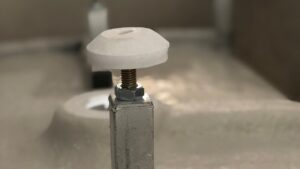
In the support photograph, a pad sits above the threaded shaft, with a nut at the metal support. This is the adjustable foot supplied for stabilizing the Gurgle tub. It is easy to overlook in a purchase because it will be largely hidden in the completed bathroom, yet the installer has to work with it before that point.
Have the installer show how the supplied feet sit on your floor while you can still see that part of the tub. Once the skirt is in place, it is much harder to understand the arrangement by looking at the finished room. A neat outline at floor level gives no view of the supports behind it.
The drawing needs to belong to the tub being supplied. A photograph of another installation cannot provide its support instructions, even if the baths look much alike. While the underside is accessible, your installer can compare the proposed arrangement with the drawing. That is the opportunity to resolve a difference, before the bath is set in place and access becomes less straightforward.
Keep the supplied guide with the order afterward. If the installation needs examining years later, the model identity and drawing will still be available. They will not reveal what was actually done in the bathroom, but they give the person investigating something more precise to start with than a photograph of a finished tub.
Care for the Finish You Bought
Cleaning and work around the bath
Mild soap, water and a soft cloth are Gurgle’s recommendation for this finish. That routine is easy enough to follow until a mark persists. The product you used successfully on nearby tile may seem an obvious next choice, but it has only proved itself on the tile. Its suitability for the acrylic still needs establishing.
The care instructions are the first place to turn when the usual cleaning leaves something behind. If you need to ask about another cleaner, give its name and label. A supplier can say more about a particular product than about the broad phrase “bathroom cleaner.” Until you have that answer, leave the unapproved product aside.
During decorating, the bath can become an inviting place to set down a tool or an open container. Give those items somewhere else to go and protect the surface while work continues. Repairing damage caused during the work is an avoidable way to begin ownership, even when the bath itself is brand new.
When the surface looks different
When a patch has changed appearance, separate what you observed from what you think caused it. “It looked dull after I cleaned it on Saturday” gives a sequence of events. “It is a stain” is already a diagnosis, and may send the conversation straight toward another cleaning product.
A photograph, the cleaner’s label and a short account of what happened are useful here. Include whether the patch was present before cleaning. That account is more helpful than a list of products you might try next.
Repeated cleaning attempts complicate that account. After three different products, it may be hard to say which change happened when. Pause while the original problem is still easy to describe.
After surface work, the repairer is the person to ask about the treated area’s care. Pass the answer on if someone else cleans the room. Otherwise, the person with the cloth may know nothing about work that took place in their absence.
When Repair or Replacement Becomes a Question
Establishing the damage
A mark can send you straight to the repair-products aisle before you know what happened. Start instead with a repairer’s assessment of the affected area. Explain when it appeared and show its position on the bath. The discussion can then cover the work needed and what you would see afterward, rather than starting with a product already chosen.
How far a line extends into the surface may need an examination rather than a photograph. Describe where it is and anything you have noticed nearby, such as moisture or movement. For a possible crack, keep the bath out of use until a professional has assessed it. There will be time to discuss the appearance of a repair after the nature of the damage is clear.
These observations lead to different conversations:
| What you have noticed | The question to resolve | Who or what helps resolve it |
|---|---|---|
| A stain or dull patch | Was there a spill or a change of cleaner? | The product label, your account and the manufacturer’s care advice |
| A scratch in the finish | How deep is it, and what finish can a repair achieve? | A repairer’s examination and explanation of the expected result |
| A possible crack | Does damage extend beyond the visible line? | Professional assessment before further use or cosmetic work |
| Water or movement returning | What caused it, and what did the earlier work address? | Investigation of the source with the previous repair details available |
Understanding a recurring problem
For a repeat problem, the earlier repair is part of the picture. What work was done, and did the trouble go away for a while? The person investigating now sees a bath that may have been altered by that work. If water is involved, tracing its escape point matters more than assuming the shell has failed because the floor is wet beside it.
The quotation should describe the whole job. Correcting the support as well as repairing a surface is more work than treating that surface alone. Replacement brings installation into the comparison too. Alongside cost, consider the repairer’s description of how the treated area will look and whether you would be happy to keep using the bath with that result.
Conclusion
The finish is the part of an acrylic bath you see every day, but it is only part of the durability question. The support and installation deserve attention before use begins. The Gurgle minimalist acrylic freestanding bathtub is the model described here, including its two-year warranty. Read that period as coverage for the purchase, not an expiry date for the bath.
Keep the model identity with the purchase record. Years later, “a white freestanding tub” will describe many products; the order details will identify the one in your bathroom.
Other shapes and finishes are grouped in the Acrylic Bathtub range. The Gurgle homepage includes the wider collection for anyone still choosing between kinds of bath. Once that choice is narrowed, compare the details of the particular models rather than transferring one model’s specification to another.
Before ordering, contacter Gurgle for the guide and care advice that belong to your chosen model and finish, together with the full warranty terms. Your installer can then discuss the same specification with you. It is also a good point to establish which replacement drain components fit, while the exact purchase details are available.
FAQ
Q: Does the warranty period tell you how long the tub will last?
A: No. Read the warranty for the coverage it offers and the steps for making a claim. A sound bath does not suddenly need removing when the period ends. Whether a fault is covered is another matter, answered by the terms rather than the number of years printed in the headline.
Q: Do acrylic tubs turn yellow?
A: A yellow area is a reason to look into what has changed, not enough information to decide on replacement. Show the affected area to the supplier with the finish and cleaning details. Whether the color developed gradually or appeared after an event is useful context. Wait for finish-specific advice before attempting to whiten it.
Q: Can a scratch be repaired without replacing the tub?
A: A repairer needs to see its depth and the surrounding finish before answering for your tub. Discuss the likely appearance after treatment as well as whether treatment is possible. You may accept a small visible difference on a bath you otherwise like; someone expecting an invisible repair needs that expectation addressed in advance.


