
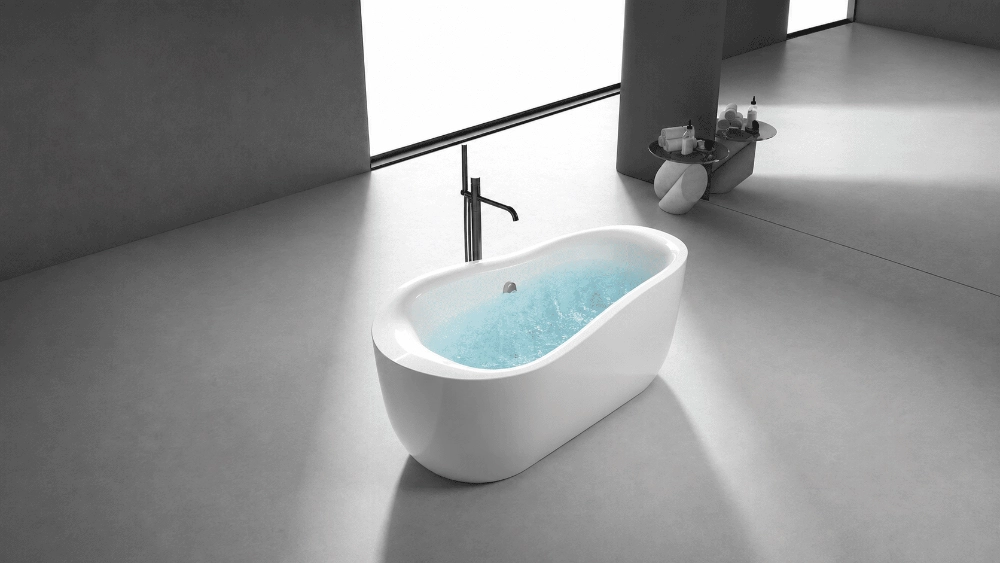
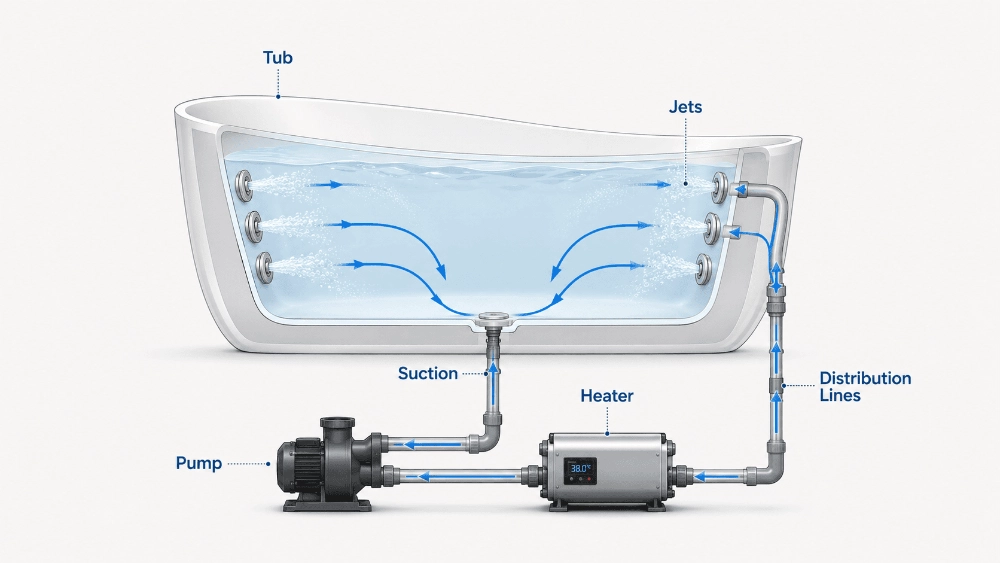
Uma banheira de hidromassagem funciona como um sistema de recirculação de água em circuito fechado. A água que já está na banheira entra por uma conexão de sucção, chega à bomba, percorre a tubulação de distribuição e retorna pelos jatos. O ar pode ser aspirado para dentro desse fluxo de retorno, alterando a sensação proporcionada pelos jatos. Um aquecedor, quando instalado, mantém a temperatura da água em circulação, enquanto os controles iniciam e interrompem cada função disponível.
A vazão depende de todo o percurso. Uma bomba grande não consegue corrigir uma abertura de sucção restrita, tubulações mal balanceadas, um jato de água inadequado ou um nível de água baixo. Um aquecedor não pode substituir o fornecimento de água quente do edifício, a menos que o sistema selecionado seja projetado para essa função. Cada componente deve ser avaliado de acordo com sua função no circuito.
O circuito de água começa e termina na banheira.
Ao contrário de uma banheira convencional que apenas enche e esvazia, uma banheira de hidromassagem recircula temporariamente a mesma água. A bomba normalmente não utiliza a rede de abastecimento do prédio durante a massagem. Ela retira água da banheira cheia, aplica pressão e a envia de volta. Quando a sessão termina, a banheira esvazia pelo ralo normal e o circuito de hidromassagem deve liberar a água retida conforme o projeto.
Os jatos, o bocal de sucção, a bomba, o diâmetro do tubo, as curvas, as válvulas e o nível da água, tudo isso afeta o funcionamento. A quantidade de jatos por si só diz pouco sobre a qualidade da massagem. Dez jatos em um circuito balanceado podem proporcionar uma sensação mais consistente do que um número maior em um circuito mal dimensionado.
O que cada componente faz
As peças principais funcionam em conjunto, não como acessórios separados. Um diagrama prático do sistema mostra o fluxo de água desde a bacia até a entrada de sucção, passando pelos equipamentos elétricos e retornando a cada saída.
Conexão de sucção e rota de entrada
A conexão de sucção admite água do banho na linha de circulação. Ela deve permanecer submersa enquanto a bomba estiver funcionando. Se o nível da água baixar muito, o ar pode entrar na linha, o fluxo se torna irregular e a bomba pode apresentar ruídos diferentes ou perda de desempenho. A conexão e qualquer tampa protetora fazem parte do sistema projetado e não devem ser removidas, bloqueadas ou substituídas por uma peça não relacionada.
Curvas acentuadas, tubulações subdimensionadas, juntas malfeitas ou detritos podem limitar a quantidade de água que chega ao impulsor. Essa restrição se manifesta rio abaixo como jatos fracos ou irregulares, mesmo com o motor em funcionamento.
Bomba para banheira de hidromassagem
A bomba converte a potência do motor em movimento da água. O impulsor aumenta a pressão e envia o fluxo para a tubulação de distribuição. A seleção da bomba deve ser adequada ao número e tipo de jatos, ao comprimento da tubulação, à resistência esperada e à alimentação elétrica. Uma potência nominal maior não significa automaticamente melhor desempenho. Vazão excessiva pode causar mau contato em algumas saídas, aumentar o ruído ou colocar o circuito fora da faixa de operação prevista.
Motores, conexões e ligações elétricas podem precisar de inspeção ou substituição. Acabamentos permanentes sobre o equipamento podem transformar um reparo comum em demolição.
Linhas de distribuição e jatos de água
Após a bomba, um coletor ou sistema de ramificação divide o fluxo entre os jatos. O comprimento e a resistência dos tubos devem ser razoavelmente equilibrados para que um lado não receba a maior parte da pressão. Na saída, o corpo do jato direciona o fluxo. Alguns projetos permitem ao usuário alterar a direção ou reduzir o fluxo, mas a faixa de ajuste é específica para cada modelo.
O posicionamento dos jatos influencia onde a água atinge, mas não garante um resultado terapêutico universal. O ângulo do assento, o tamanho do corpo, o nível de enchimento, o design da saída e a configuração da bomba alteram a experiência. Compare o conjunto completo do assento e do sistema hidráulico, em vez de considerar todos os jatos como idênticos.
Mistura de ar
Muitos jatos de água utilizam o efeito Venturi para aspirar ar para dentro do fluxo pressurizado. O ar fragmenta a água, tornando-a mais agitada e alterando a sensação na saída. Uma válvula de controle de ar permite ao banhista reduzir ou aumentar essa mistura. Ainda assim, trata-se de uma banheira de hidromassagem com jatos de água, pois a bomba está circulando a água. Não deve ser confundida com um banho de ar, que utiliza um soprador para injetar ar através de aberturas separadas.
O que o aquecedor realmente faz
Um aquecedor de banheira de hidromassagem geralmente é um aquecedor de manutenção. Sua função é retardar a perda de temperatura enquanto a bomba circula a água. Não é seguro presumir que todo aquecedor aquecerá uma banheira fria até a temperatura desejada ou manterá uma temperatura exata em todos os ambientes. O volume da banheira, a temperatura inicial, as condições do ambiente, o material da banheira, a taxa de circulação, a potência do aquecedor, os controles e a duração da sessão são fatores importantes.
Algumas banheiras de hidromassagem não possuem aquecedor embutido, enquanto outras oferecem essa opção. Os controles podem permitir o aquecimento apenas enquanto a água estiver circulando. Banheiras de imersão, banheiras de hidromassagem com jatos d'água, banheiras de ar e banheiras combinadas precisam de descrições de pedido separadas; a configuração selecionada deve especificar quais funções de massagem e aquecimento estão incluídas.
Um comprador comparando modelos de banheiras de hidromassagem É preciso perguntar se o aquecedor está incluído, é opcional ou não está disponível; qual a alimentação elétrica necessária; como ele é controlado; e qual o comportamento da temperatura que o fornecedor realmente indica para essa configuração. Uma etiqueta genérica de aquecedor não é suficiente.
Os controles coordenam as funções disponíveis.
Os controles podem utilizar botões pneumáticos, chaves eletrônicas ou um painel digital para operar a bomba, o controle de ar, o aquecedor, a luz ou outras funções integradas. Dispositivos de intertravamento podem impedir o funcionamento do equipamento caso não haja fluxo suficiente. Analise as informações de operação e fiação do sistema selecionado antes de iniciar os trabalhos no local.
A proteção elétrica deve ser instalada antes do fechamento da banheira. Diretrizes da NFPA sobre proteção GFCI Este documento explica o papel dos interruptores de circuito de falha à terra em locais úmidos, de acordo com o contexto do código americano citado. O circuito final, o isolamento, a ligação equipotencial, a proteção e o arranjo de acesso devem seguir as normas e as qualificações aplicáveis no local da instalação.
Banhos de jato de água, ar e combinados são sistemas diferentes.
Uma banheira de hidromassagem com jatos de água utiliza uma bomba e tubulações cheias de água. Uma banheira de hidromassagem com ar utiliza um soprador e canais de ar, produzindo muitas bolhas menores em vez de jatos de água concentrados. Uma banheira combinada inclui ambos os sistemas, às vezes com controles independentes. Os nomes não devem ser trocados, pois as rotinas de limpeza, a retenção de água, o ruído, a sensação da massagem, as necessidades de energia e as peças de reposição são diferentes.
Gorgolejo Fornece banheiras de hidromassagem para uso interno, com configurações de jatos de água e combinadas, mas cada sistema selecionado ainda precisa de uma lista de equipamentos específica do modelo.
UM modelo de banheira de hidromassagem independente com 10 jatos Oferece aos compradores uma configuração concreta para análise. As informações atuais sobre bomba, aquecedor, voltagem, controles, dreno e acesso para manutenção devem ser verificadas em conjunto, em vez de inferidas a partir do nome da categoria.

Por que os sistemas parecem fracos, desequilibrados ou instáveis?
Jatos fracos podem ser causados por baixo nível de água, sucção restrita, controles fechados, ar preso, detritos, ramificações desequilibradas, seleção inadequada da bomba ou um problema elétrico. A vazão irregular geralmente indica um problema de distribuição, e não apenas na quantidade de saídas. Verifique o circuito e as instruções de serviço do fabricante. Operar a bomba a seco ou ligar equipamentos elétricos incorretamente pode causar danos ou riscos à segurança.
Em caso de reclamações sobre a temperatura, primeiro confirme se há um aquecedor instalado e qual a sua função declarada. Em seguida, verifique a temperatura inicial, o fluxo, as configurações, as condições do ambiente e a duração da sessão. Um aquecedor de manutenção não pode ser avaliado da mesma forma que um aquecedor de água independente, e um visor de controle não garante uma temperatura uniforme em toda a banheira.
A drenagem também é importante após o uso. O trajeto da tubulação e o design do jato influenciam a quantidade de água que permanece no circuito interno. Os compradores devem solicitar as instruções de limpeza e drenagem específicas para o modelo, principalmente em locais onde a troca de banheira é frequente. O acesso para manutenção e o método de limpeza recomendado devem constar nas especificações antes da instalação da banheira.
O que os compradores devem confirmar para o modelo selecionado
Um orçamento completo deve identificar o modelo da banheira, o tipo e a quantidade de jatos, o modelo ou a potência da bomba, o estado do aquecedor e o sistema de controle. Os detalhes da instalação incluem voltagem, frequência e proteção necessária. Os sistemas de drenagem e transbordamento, a posição do painel de acesso e as conexões incluídas devem constar no mesmo pedido. O desenho deve mostrar a conexão de sucção, o compartimento do equipamento, o trajeto da tubulação principal, os controles e a abertura de serviço. Se as opções alterarem o equipamento, o desenho revisado deverá seguir a configuração final.
Para banheiras de hidromassagem Gurgle, o teste de água é realizado antes da inspeção final e abrange as bombas, jatos, aquecedores, drenos, pontos de transbordamento, conexões e o estado geral do equipamento. Os compradores podem utilizar a mesma sequência de componentes ao aprovar os registros de inspeção: encher acima do nível operacional, acionar as funções instaladas, observar o fluxo e os controles, verificar as conexões, testar a drenagem e registrar o resultado para a unidade encomendada. O escopo do teste e os critérios de aceitação ainda precisam ser acordados por escrito.
Uma boa especificação segue a água.
Jatos, bombas, aquecedores, controles e drenos só fazem sentido como um único circuito. Comece na conexão de sucção, siga o percurso pela bomba e pelo aquecedor (opcional), verifique como o fluxo se divide e termine nas saídas e no dreno. Essa abordagem expõe problemas como acessos incompatíveis, opções imprecisas e especificações de temperatura vagas antes da instalação.
Para uma revisão em nível de modelo, Envie à equipe de produto as dimensões necessárias da banheira, a alimentação elétrica, as funções e as restrições de serviço.A resposta pode então ser vinculada a uma configuração selecionada, em vez de uma descrição geral de banheiras de hidromassagem.
Perguntas frequentes
P: O equipamento da banheira de hidromassagem deve ser consertado antes da aprovação do pedido da banheira?
A: Sim. A bomba, o aquecedor, os controles, a voltagem, o layout dos jatos e o acesso para manutenção afetam a configuração final e a preparação do local. Defina a lista de equipamentos antes de aprovar o pedido.
P: Quais detalhes das peças sobressalentes devem ser registrados junto com a banheira?
A: Registre os números de modelo da bomba, do aquecedor e do controlador, as especificações elétricas, os detalhes de conexão e as referências de substituição compatíveis para a configuração selecionada.
P: A bomba e o aquecedor da banheira de hidromassagem podem compartilhar o mesmo circuito elétrico?
A: Não presuma que eles consigam. O arranjo do circuito depende do equipamento selecionado e das normas elétricas locais. Utilize os documentos de fiação do fornecedor e solicite a um eletricista qualificado que confirme a alimentação, a proteção, o isolamento e a ligação equipotencial antes da instalação.


