
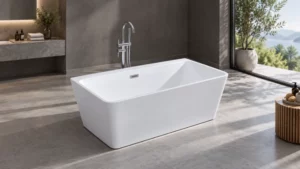
For a bulk acrylic bathtub order, begin with an approved sample, a model-specific drawing, and clear inspection criteria. A glossy showroom finish cannot confirm reinforcement, water tightness, dimensions, fittings, or packing. Buyers need records that tie these checks to the exact configuration being ordered, so the factory and receiving team can identify a defect or mismatch before the batch is accepted.
Set the Approval Reference Before Sampling
Start with a model-specific drawing and a written specification. Record external and internal dimensions, rim shape, drain and overflow positions, support points, finish, color, hardware, and the intended installation orientation. A bulk order becomes difficult to control when the sample is approved by a photograph while the factory builds from a different drawing.
Define what the sample represents
The approved sample should identify the acrylic surface, reinforcement arrangement, base or frame support, fittings, and packaging marks. If the final project uses a custom size or a changed drain, treat that configuration as a new approval item. A sample proves the selected configuration, not every bathtub in a supplier’s catalogue.
Agree the acceptance language
Terms such as white, glossy, matte, strong, or premium are not acceptance criteria. Record a color reference, viewing conditions, acceptable marks, measurable tolerances, and the checking method. Both the factory and the receiving inspector should apply the same rules.
Inspect the Acrylic Surface and Reinforcement
Acrylic bathtub quality is not decided by sheet thickness alone. Under consistent lighting, inspect for pinholes, scratches, waviness, color variation, contamination, and damage along trimmed rims and corners. Check whether the approved construction specifies fiberglass-and-resin reinforcement and where the support zones should be. Gurgle’s production materials describe fiberglass reinforcement using INEOS resin; the actual construction and locations still need to match the selected model.
Look at the surface in controlled conditions
Review the sample at normal viewing distance and at close range. Use the same light direction for the reference and the production sample. Photograph any accepted marks and record their location. A surface that looks uniform in a small image may show a different texture when the tub is viewed across a full rim or curved wall.
Check the underside and support
Inspect the underside on a safely supported sample or through clear factory inspection photographs, with direct examination where practical. Compare the reinforcement and support contact points with the approved construction drawing; note loose material, voids, or distortion. Do not assume the shell alone carries the full load. The feet, frame, base, and intended floor support must work together.
Use Water and Drain Tests as Release Evidence
Gurgle states that every bathtub is water-tested and inspected before packing and shipment. Its documented quality-control workflow describes checking the fittings, filling above the overflow, examining leakage, and testing drainage and visible deformation. The internal procedure also describes a 24-hour static leakage check. Confirm the scope and test duration for the selected model rather than treating this reference as a universal certificate for every order.
Test the drain and overflow
Confirm that the drain opens, seals, and empties without an unexpected backup. Check the overflow path and its connection to the waste line. The test should use the fittings supplied with the order because a factory test with a different drain set cannot prove the final assembly.
Record static leakage and deformation
Record seepage at the drain or overflow, changes around the support points, shell movement, and cracks against the agreed test conditions. Factory water testing and buyer-side lot acceptance are different controls: the buyer may sample dimensions, finish, fittings, and records, but sampling does not replace the manufacturer’s stated pre-shipment water tests. If a leakage test fails, the affected units and re-test requirements must be resolved before release.
Control Dimensions, Fit, and Finish Across the Batch
Measure the features that affect installation, not only the longest outside dimension. Check rim height, base position, drain center, overflow height, internal length, internal width, and any wall or floor contact that appears on the drawing. For hotel or apartment projects, small repeated shifts can become a visible alignment problem when several bathrooms are installed beside one another.
Repeatable measurement points
If an accepted tolerance is needed, use a consistent instrument and measurement point. Record the actual result rather than writing only pass or fail. When a supplier offers several models in an серия акриловых ванн, keep each model code separate. A broad catalogue dimension cannot replace a drawing for the selected bathtub.
Receiving-room fit
The receiving team should also know which dimensions affect adjacent work. A drain that shifts only a small amount can change the waste connection, while a rim or base variation can alter the finished joint at a wall, deck, or floor. For repeated rooms, keep one marked-up installation drawing with the approved measurement points. Compare the first delivered unit with that record before unpacking the full shipment. If the project has a stone floor, raised platform, or concealed waste, confirm the tolerance with the installer rather than relying on a general catalogue range.
Finish approval conditions
Finish checks need a fixed lighting condition and an approved sample, not a subjective judgment in the warehouse. Curved acrylic can reflect light differently across the shell. Document the expected color, gloss, and surface texture, then photograph accepted variations under the same conditions used for inspection.
Keep dated sample photographs with the model code and finish reference. When later shipments or replacements arrive, inspectors can compare the same surfaces under matching light and record any change rather than relying only on the carton label.
Review Finish, Fittings, and Documentation
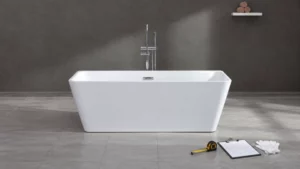
The final inspection must match the supplied configuration: drain and overflow set, support or feet, labels, required country-of-origin marks, and installation documents. Gurgle’s production process covers forming, reinforcement, trimming, assembly, water testing, polishing, final inspection, and packing. Buyers should request the model-specific inspection scope and identify which records will accompany each shipment.
For a large order, define the first article, the number of units inspected, the defect classes, the response to a failed sample, and who signs the release. A lot acceptance sampling plan sets out the sample and the rules for accepting or rejecting a lot. The project team still needs to choose an inspection level and acceptance rule suited to the product and risk; a general sampling method does not decide the buyer’s tolerance automatically.
For a product-level check, Gurgle’s back-to-wall freestanding bathtub lists 100% pure acrylic sheet, 1500 × 750 × 580 mm or 1700 × 750 × 580 mm, gloss or matte finishes, and seven-layer carton packaging. Check the chosen size, finish, drain set, and packing against one approved drawing.
Protect the Product During Packing and Delivery
Packing should protect the rim, corners, base, finish, and loose fittings throughout handling. Gurgle lists Grade A seven-layer carton packaging on selected acrylic products, but buyers still need to confirm the actual packing specification for their order. Record corner and base protection, marks, packed size, and pre-loading photographs; do not assume one carton method suits every configuration.
Packed dimensions and weight affect unloading, storage, and the route to installation. Give the receiving team a damage-report method for crushed corners, wet cartons, or marks on the acrylic before units are installed.
Turn the Checks Into a Bulk-Order Release File
The release file should bring together the approved drawing, sample photographs, measured values, factory water-test evidence, finish reference, component list, packing specification, and action taken on failures. Keep one model code and revision on every record. If a drain set, support detail, or finish changes after approval, identify which checks need repeating before authorizing the shipment.
| Inspection point | Evidence to retain |
| Acrylic and support | Material specification, approved underside reference |
| Finish | Approved sample, photo and agreed defect criteria |
| Water and drainage | Applicable water-test record, drain/overflow check |
| Размеры | Measured results against the approved drawing |
| Fittings | Confirmed component list and installation details |
| Packing | Carton specification and pre-loading photos |
Acrylic freestanding tubs can suit residential, hospitality, and developer projects when the selected model, support, finish, and installation information are aligned. Бульканье offers a freestanding bathtub range, while the final order should be based on the chosen drawing and inspection record.
Заключение
Acrylic bathtub quality checks are most useful when the sample, factory test evidence, lot inspection, and packing approval all refer to the same drawing revision. Hold any unresolved material, leakage, or dimensional mismatch before release. For help aligning a sample and inspection plan to a bulk order, discuss the requirements with Gurgle before confirming production.
Часто задаваемые вопросы
Q1: Should every bathtub in a bulk order be water tested?
A1: Gurgle states that every bathtub is water-tested and inspected before shipment. Buyer-side sampling is a separate acceptance step for measurements, finish, fittings, and records. Ask which test conditions apply to the ordered model and what evidence will be provided; do not equate a sampled lot check with the factory’s own water-test process.
Q2: What is the most important acrylic bathtub quality check?
A2: No single check is sufficient. Compare acrylic finish, reinforcement and support, water tightness, dimensions, fittings, and packing against the same approved sample and drawing.
Q3: Can a product photo replace a physical approval sample?
A3: A photo helps document a model or finish, but it cannot demonstrate underside support, actual fittings, or leakage performance. Use a physical sample or agreed first article alongside drawings and test records.


