
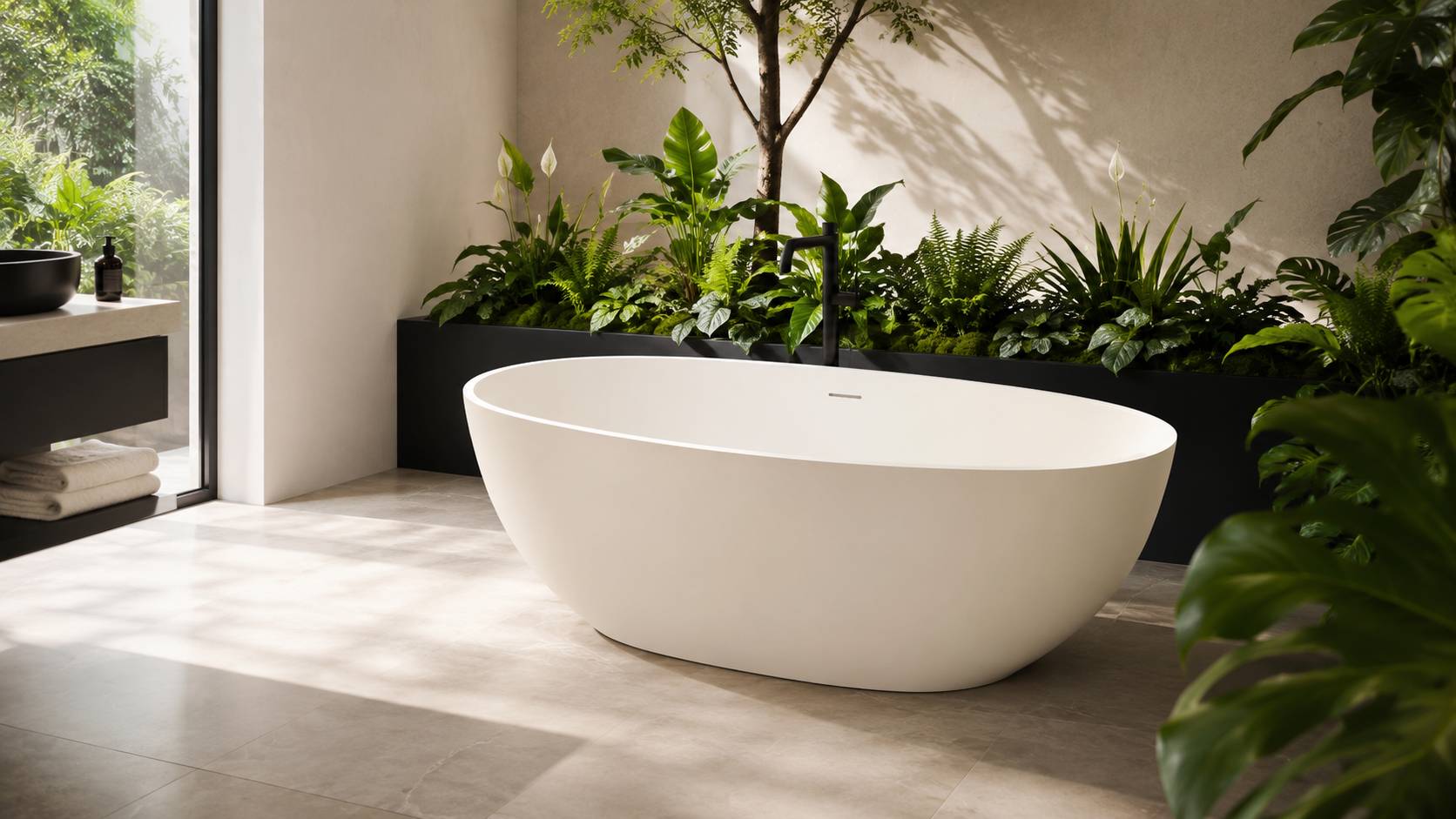
An oval artificial stone bathtub is not only an appearance choice. For hotel, resort, spa, and premium residential projects, the same product decision also affects product weight, access routes, drain position, packaging, floor conditions, and certificate review. A practical purchase review starts with material choice, then moves into project fit, installation planning, packaging, transport, and final order confirmation. These checks should happen before any drawing, sample approval, delivery route, or purchase order is treated as ready for the project site.
Material Choice: What Artificial Stone Means for Buyers
Artificial stone tubs in this category are formed by casting mixed material into a mold, followed by curing, demolding, sanding, and surface finishing. This process supports continuous curves and a substantial solid-surface appearance. Buyers should confirm the material specification, surface structure, finish, and recommended repair method for the selected model before approval.
Lightweight sheet-formed acrylic tubs can be more practical where low weight and easier handling are the main priorities. This cast artificial stone model is better suited to briefs that call for a low-gloss matte surface, a substantial bath area, and a finish for hotel bathrooms, resort villas, or spa-style suites. Its main trade-offs are weight, handling effort, and cost, which should be reviewed early for upper-floor bathrooms and restricted access routes.
Buyers can compare other artificial stone models, but each selected bathtub should still be reviewed by its own dimensions, weight, finish, drain configuration, and packaging details.
Product Specifications Buyers Should Review
The Artificial Stone Bathtub uses composite acrylic, a matte finish, and an oval freestanding profile. It is offered in seven listed sizes from 1400 mm to 1800 mm in length. For procurement teams, these specifications support room planning, floor checks, delivery coordination, packaging review, and document requests.
| Item | Confirmed Detail |
| Material | Composite acrylic |
| Dimensions | Seven options from 1400 × 750 × 520 mm to 1800 × 800 × 550 mm |
| Capacity | 295–357 L |
| Listed product weight | 137 kg; confirm for the selected size |
| Surface | Matte finish |
| Packaging | Grade A 7-layer carton with protective cushioning and wooden support |
| Warranty | 2 years |
For a hotel bathtub specification or villa project review, the size options help different teams work from the same baseline. Designers can select the footprint that fits the planned visual centerline. Contractors can review rough-in position and handling route. Procurement teams can compare packaging, warranty, and document requests before placing a multi-room order.
Oval Shape and Project Layout
An oval freestanding bathtub reduces the visual rigidity of rectangular bathroom layouts. Straight tile lines, glass partitions, vanities, and wall panels can make a room feel strict. A rounded matte freestanding bathtub gives the bath area a softer visual profile without turning the space into a decorative showpiece. That balance matters in B2B projects where the tub must look premium but still fit repeatable room planning.
Plan visible clearance around all sides
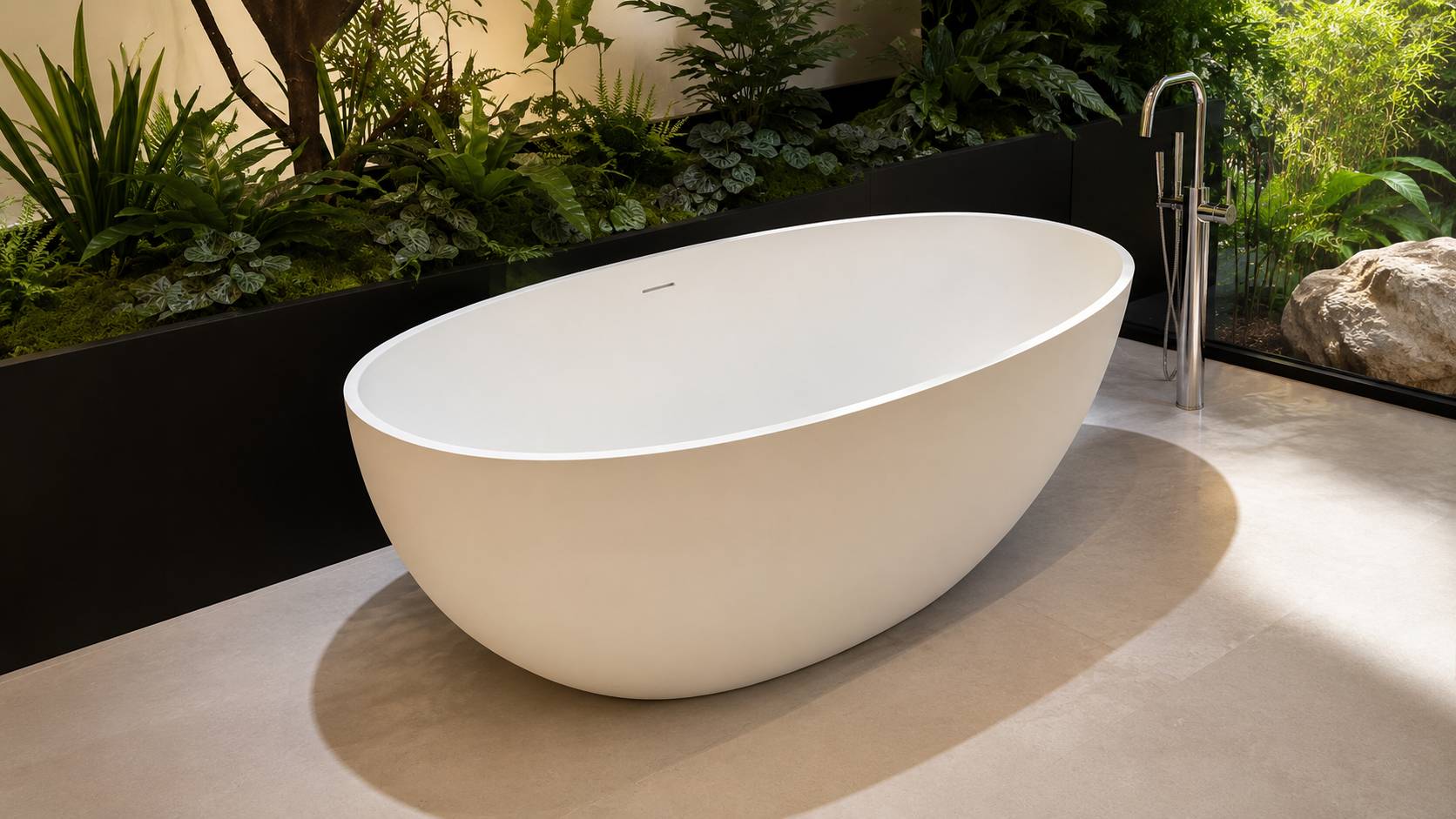
Because the tub is freestanding, it is normally viewed from more than one side. The surrounding floor area, cleaning access, faucet reach, and sightline from the bathroom entrance all matter. A tight corner may reduce the value of the oval form. Buyers should confirm the planned tub location with a scaled drawing, not only with a mood board or product photo.
Match weight and route to the project site
Artificial stone tub weight affects more than unloading. The product page lists a weight of 137 kg, but buyers should confirm the final net weight for the selected size and order. That figure must then be reviewed with the filled water load, user load, floor structure, elevator access, stair clearance, corridor width, and turning space. Commercial projects need a practical route from vehicle unloading to the final bathroom position.
Entry, Installation, and Drain Coordination
Freestanding bathtub installation is usually more coordinated when the drain, overflow, faucet position, and finished floor are planned together. A late change around the drain can affect the tub centerline, the visible filler location, and the clean appearance of the finished bathroom.
Check access before confirming the order
The seven available size options provide several planning choices, but the access route is just as important as the selected footprint. Door width, packaging size, stair turns, corridor corners, and the point where protective packing is removed should be discussed before ordering. This is especially important for boutique hotels, resort villas, and renovation projects where finished surfaces may already be in place.
Coordinate drain, overflow, and faucet details
This model uses a one-piece overflow water outlet and a pop-up drain designed to reduce leakage around the fitting and limit blockage from small debris. Buyers should still confirm the installation drawing, drain position, compatible waste fittings, overflow direction, maintenance requirements, and faucet plan. A floor-mounted faucet, wall-mounted faucet, or deck-adjacent filler can change both appearance and installation work.
Certificates, Packaging, and Purchase Confirmation
B2B buyers should separate product documentation from factory quality management information. Buyers should request current CE, cUPC, and RoHS documents for the selected model and destination market. ISO 9001-related factory quality management information should be reviewed separately. The document name, issuing body, validity period, and model coverage should be checked before treating any certificate as order-ready evidence.
Review Production-Site Controls
During factory evaluation, buyers may ask how dust is controlled during material mixing, sanding, and surface finishing. This is a factory-process check rather than a product performance test, so it should be documented separately from bathtub inspection and certification.
Confirm packaging and transport details
Packaging is a major part of an artificial stone tub order because weight and surface finish both affect shipping risk. The listed packaging uses a Grade A 7-layer carton with protective cushioning and wooden support. Before a larger order, buyers should confirm package dimensions, stacking limits, loading method, carton marking, pallet or crate requirements, and who is responsible for unloading at the destination site.
For long-distance shipping, the buyer should also confirm how the bathtub is protected at corners, rim edges, drain hardware, and visible matte surfaces. A project with multiple rooms may need consistent carton labels, room-by-room delivery notes, and a clear damage-inspection process when goods arrive. These details sound operational, but they directly affect whether a premium bathtub reaches the bathroom in usable condition.
Where This Artificial Stone Bathtub Fits Best
This artificial stone bathtub is better suited to projects that provide sufficient visual clearance, structural capacity, and delivery access. Boutique hotel bathrooms, resort villas, spa-style suites, and premium residential bathrooms can be suitable when the selected size has adequate surrounding space and the site can accommodate its weight and drain position. Compact rooms with narrow doorways, limited floor capacity, or fixed drainage may require a lighter or differently configured model.
The product also suits buyers who want a matte freestanding bathtub with a substantial solid-surface appearance and several size choices, but who are prepared to confirm site handling in detail. It is less suitable when the main requirement is the lightest possible tub, the fastest upstairs handling, or a layout where a built-in or corner bathtub would solve access issues more cleanly.
Conclusion
An artificial stone freestanding bathtub is easier to specify when the buyer treats material, size, access, drain planning, packaging, and documentation as one purchase decision. The matte finish and oval profile support a substantial visual result, while the listed weight and freestanding format call for careful site review. Before confirming the order, buyers should request the selected-size drawing, final weight, certificate documents, packaging details, delivery route plan, and finish sample or close product photo.
For project-specific questions about finish, size, packaging, certificates, or delivery access, buyers can contact the Gurgle team before finalizing the order for the site.
Buyers who need model adaptation can also review Gurgle’s OEM/ODM support for size, appearance, and order discussion.
For a broader comparison of materials, sizes, finishes, installation requirements, and maintenance, read the complete stone bathtub buying guide.
FAQ
Q:What material is used for this artificial stone bathtub?
A:The product is listed with composite acrylic material and a matte surface finish. Buyers should still confirm the material specification, color, surface sample, and maintenance method for the selected size before approving a project order.
Q:Is this oval freestanding bathtub suitable for hotel projects?
A:Yes, when the bathroom layout, floor capacity, access route, drain position, and certificate requirements are checked in advance. Boutique hotel bathrooms and spa-style suites are good candidates when there is enough space around the tub.
Q:What should buyers confirm before ordering this bathtub?
A:Key checks include the selected dimensions, final net weight, material specification, surface sample or close product photo, installation drawing, drain and overflow details, faucet plan, certificate documents, package dimensions, unloading method, and delivery route. The listed 137 kg weight should be reconfirmed for the chosen size and order.


