
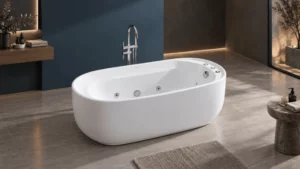
The right depth for a freestanding soaking tub cannot be chosen from the outside height alone. A tub can look tall but offer limited water depth, or have a moderate exterior with a more usable bathing well. For buyers, the useful question is whether the interior depth, overflow position, tub length, bottom shape, and entry height work together for the people and bathrooms the product will serve.
For many reclining soaking tubs, a usable water depth in the mid-to-high teens can provide substantial immersion, while deeper designs may exceed 20 inches. The exact number should still be checked against the overflow position, body posture, entry height, and the selected product drawing.
What “Depth” Means in a Soaking Tub
The word depth is used for several different measurements. Separating them early makes the buying decision much more reliable.
Measure the interior water depth
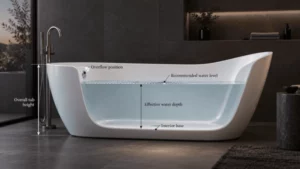
Overall tub height is the distance from the floor to the highest outside edge. It is useful for entry planning, but it does not tell the buyer how much water reaches the bather. Effective water depth is measured inside the tub, from the bathing surface to the water level near the overflow. The interior depth may be reduced by a raised seat, sloped base, molded lumbar area, or a high floor beneath the legs.
Ask for a dimension drawing that identifies the interior base, overflow height, and recommended fill level. A single “tub height” number is not enough for comparing soaking tub dimensions for adults, because depth at the center can differ from depth near the backrest or drain.
Check the overflow and the bathing posture
The overflow sets a practical upper limit for the water. It is not a guarantee of the water line at every point in the tub. A reclined bather may have the shoulders higher than the hips, while a steeply sloped back can shift the body forward and change how much of the torso is immersed.
Review the backrest angle, internal length, bottom width, and drain position together. A deep soaking tub that is too short may force a tall user into a bent-knee posture, while a long interior with a shallow well may fail the intended soaking brief. Compare water depth with body position, not the largest catalog number.
Match Effective Depth to Body Fit and Daily Use
There is no single best soaking tub depth for every user or project. The correct range depends on the people who will use the bath, the way they enter and leave it, and the room in which it will be installed.
Use body measurements, not a generic label
For a freestanding soaking tub, compare the interior length from the backrest to the opposite end with the user’s seated or reclined body length. Hip width and shoulder room matter as well. A narrow base can limit turning and make a deep tub feel restrictive, even when the waterline is high enough.
Buyers planning a product range can request more than one interior option rather than assigning one exterior size to every customer. Review a showroom sample in the same posture the target user will adopt, especially when internal depth and overflow reference are missing.
Treat entry height as part of the depth decision
A higher rim can provide more wall height around the water, but it also raises the step-in movement. Users with limited balance, reduced leg strength, or restricted mobility may need a different fixture or professional advice before a deep tub is selected. A low threshold, grab bar plan, transfer seat, or walk-in configuration can be more important than extra water depth for that user group.
For U.S. projects where ADA accessibility requirements apply, bathing fixtures also need to be checked against the relevant provisions. The ADA bathtub provisions address clear floor space, controls, grab bars, and seats for accessible fixtures. They do not make every freestanding tub compliant, but they show why entry, controls, and transfer space belong in the same review as depth.
Check the Room Before Choosing a Deep Soaking Tub
Interior comfort can be lost if the tub cannot be moved into the room, drained properly, or serviced after installation.
Confirm floor, route, and surrounding clearances
Freestanding tubs expose more bathroom floor than built-in units, so the installer needs a level surface and a practical delivery route. Measure doorways, turns, stair landings, and the final position before ordering. Packaging dimensions may be larger than the product itself.
Leave space around the rim for cleaning and around the plumbing connection for inspection. A high-sided tub pushed too close to a wall can make the outer surface difficult to wipe or block access to the drain. In rental, hospitality, or developer projects, repeatable access matters more than a single display installation.
Match water demand and drainage to the site
Greater effective depth can mean more water is needed to reach the planned bathing level. The requirement depends on tub shape, user displacement, overflow height, and local water pressure. Compare the selected model’s stated capacity with the available hot-water system instead of treating “deep” as a purely comfort-related feature.
Drain position and discharge route deserve the same attention. A freestanding tub may need a floor outlet in a precise location, and finished floor height can affect the connection. Confirm the drain, overflow, trap arrangement, and testing access before the floor is closed. Keep a separate drawing and plumbing schedule for each size.
How to Compare Acrylic Freestanding Soaking Tubs
Acrylic is common in freestanding soaking tubs because it supports formed shapes and a broad range of sizes. The material name alone, however, does not answer the buyer’s questions about structure, finish, or inspection.
Review the construction and finish details
Der Acrylbadewannen-Sortiment should be compared through a complete specification set: sheet or surface description, reinforcement method, frame or base support, drain and overflow components, finish, color reference, and available dimensions. If a model includes a sloped back, molded arm area, or raised floor, those features should appear on the drawing because they change the effective bathing space.
Project buyers should ask how color and surface acceptance will be checked. Record finish, color, drain position, and interior dimensions with the sample so the batch has a fixed reference.
Use water testing as a practical quality check
Gurgeln‘s bathtub production process includes forming, reinforcement, trimming, assembly, water testing, final inspection, cleaning, and packaging. These steps are useful buying checkpoints, but the purchaser should still request the inspection scope for the selected model and state which configuration was tested.
What Buyers Should Put in the Soaking Tub Brief
The best question is not simply “How deep is the tub?” A usable brief turns the bathing objective into measurable requirements that a supplier can quote and a project team can approve.
Request a complete dimension set
Ask for overall length, width, and height together with internal length, internal width, effective water depth, overflow height, rim thickness, base footprint, and water capacity. Include the backrest angle, drain center, overflow position, and recommended fill level when those dimensions affect the intended posture.
For a small bathroom, add door and route measurements. For a hospitality or housing project, specify the size mix, room type, expected user profile, and whether the same drain and faucet arrangement must repeat across units. These details allow a buyer to compare a deep soaking tub with a standard model on usable fit rather than on exterior appearance.
Tie the sample to the final order
The quotation should identify the approved drawing, finish, color, drain and overflow set, packaging marks, and inspection points. Custom dimensions need separate RFQ lines. A sample with a different interior depth or overflow position cannot represent the final installation.
After the checks are complete, buyers can review the wider freestanding bathtub collection by interior fit, effective depth, and room requirements. Keep the shortlist tied to the same drawing criteria so a change in model does not silently change the overflow, drain, or usable bathing space.
Abschluss
The useful depth of a freestanding soaking tub is the interior water depth at a practical fill level, evaluated together with the overflow, bottom shape, backrest, internal length, rim height, and entry movement. Buyers who compare only the exterior height can miss the fit problem that appears after installation. A better decision starts with a dimension drawing, a room and water-supply check, and a sample tied to the final configuration. For project pricing or model comparison, Kontaktieren Sie das Gurgle-Team with the intended size mix, interior depth target, finish, drain details, and site limits.
Häufig gestellte Fragen
Q1: Is a deeper soaking tub always better?
A1: No. More depth may improve immersion for some users, but it can also raise the rim, increase water demand, and make entry harder. Compare effective water depth with body fit, step-in height, room access, and professional guidance where mobility is limited.
Q2: How is effective water depth different from tub height?
A2: Tub height measures the outside distance from the floor to the rim. Effective water depth describes the inside distance from the bathing surface to the water level near the overflow. The measurements should be shown separately on the product drawing.
Q3: What should be checked before ordering a deep freestanding tub?
A3: Confirm internal and external dimensions, overflow and drain positions, water capacity, delivery route, hot-water supply, finish, inspection scope, and the exact drawing used for the sample and final order. Installation instructions and local requirements still control the final decision.


